
In this article, I aim to address the various forms of saddle discomfort and why choosing the right saddle can help avoid these discomforts, or at least to alleviate them.
In addition to the appropriate saddle, an incorrect position on the bike is also a significant cause of saddle sore. I will address this in a subsequent blog post.
This article is the result of my experiences in the bike shop. Additionally, I have been inspired by the SQ Lab – Ergonomics Guide and the articles by Juliane Neuß on bike ergonomics.
The width of the saddle
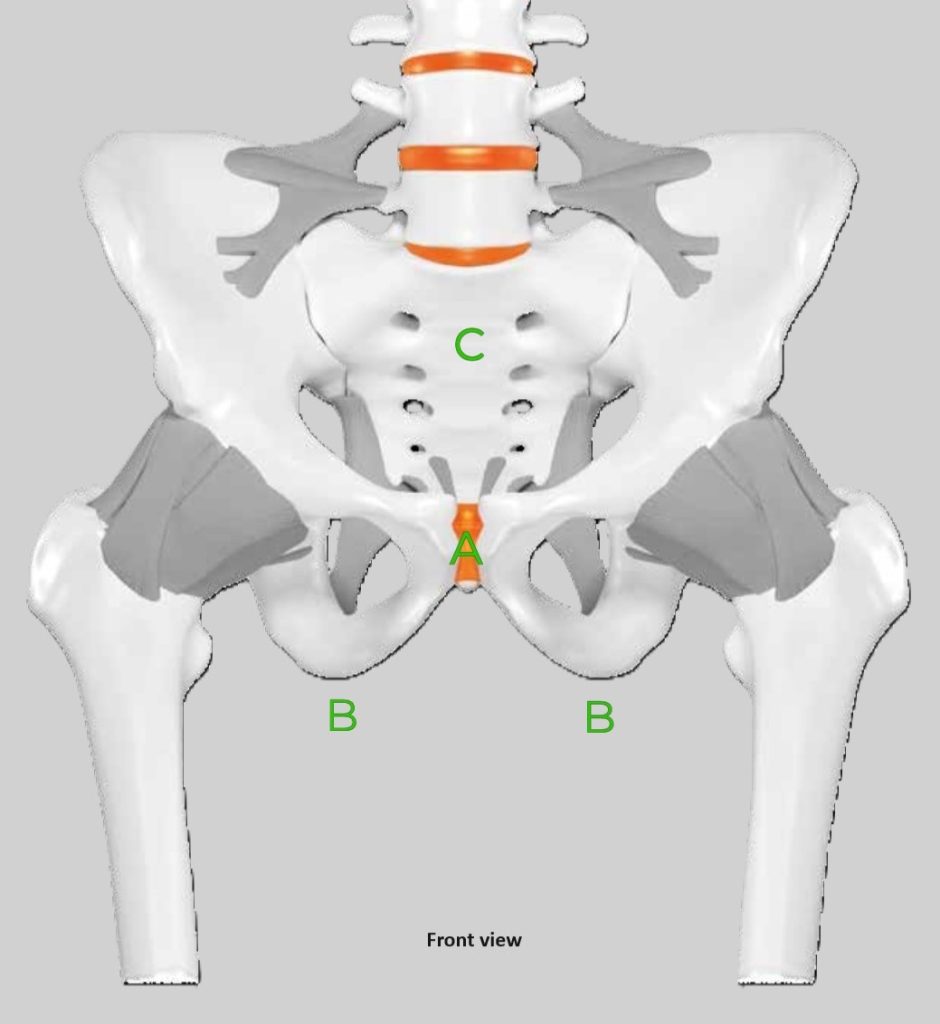
The pelvis is the central point in our body. From above, the spine is connected to the pelvis via the sacrum (Figure 1: C). And at the sides, the thighs end in the mobile hip joints. From the widest point at the sit bones, the sitting and pubic bones form an inverted V. The pubic arch (Fig 1: A) coincides with the point of this inverted V.
When you ride upright (approximately 90°), the sit bones (Fig 1: B) at the bottom of the pelvis bear the body’s weight. The more upright you ride, the more weight your pelvis has to support. In principle, the sit bones can withstand this high pressure.
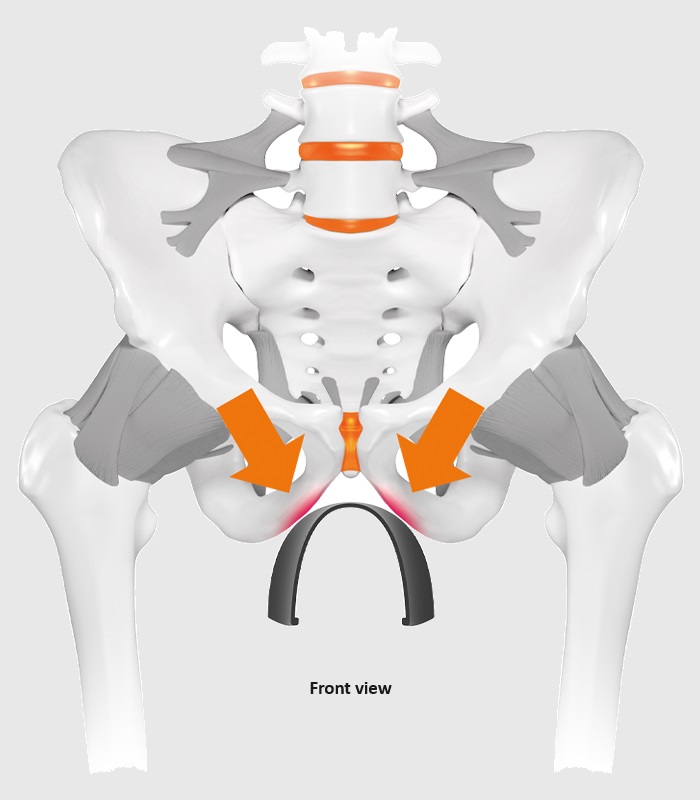
As you sit more sportively, meaning more leaned forward on the bike, your pelvis tilts. The sit bones lift off the saddle, and the bottom of the pelvis (pubic bones and pubic arch) now rests on the saddle. The pressure points move forward, towards the pubic arch. Additionally, in a more sportive position, there is a shift of weight away from the pelvis. More weight is then placed on your hands.
The sportier your cycling posture, the more your pressure points shift towards the pubic arch and thus come closer together. If you want the saddle to fit nicely with your pressure points, it should be narrower.
It is now clear that your riding position influences the appropriate saddle. Additionally, your own physiology matters. The distance between the sit bones varies from person to person. Contrary to popular belief, there are no pronounced differences between men and women in this regard.
When you ride upright on a saddle that is too narrow, the saddle will not provide enough support where you need it. The saddle supports your sit bones too close to the point of the inverted V, which leads to excessive pressure in the pubic area (Fig 2). This manifests itself as numbness.
Saddles come in various widths. If your riding position is more upright, it is important to choose a saddle that matches your physiology. With the rise of the e-bike, we see that more people are opting for an upright riding position. After all, with an e-bike, posture is of secondary importance for efficient forward motion. At Velonaut, we therefore advocate for a measurement of your sit bone width. This helps you get started in choosing a saddle with the appropriate width.
A lower nose
We also advocate for saddles with a lowered nose or a saddle nose with an opening.
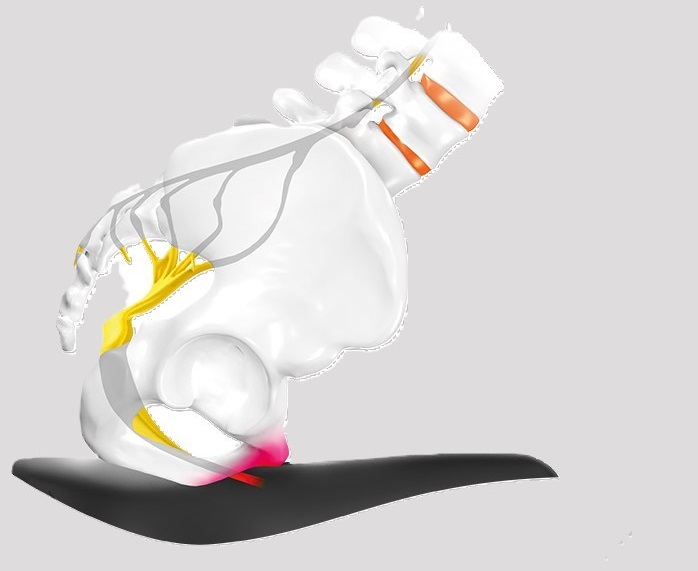
For men, this helps reduce excessive pressure on the genital area, especially as the riding position becomes more sportive (Fig 3).
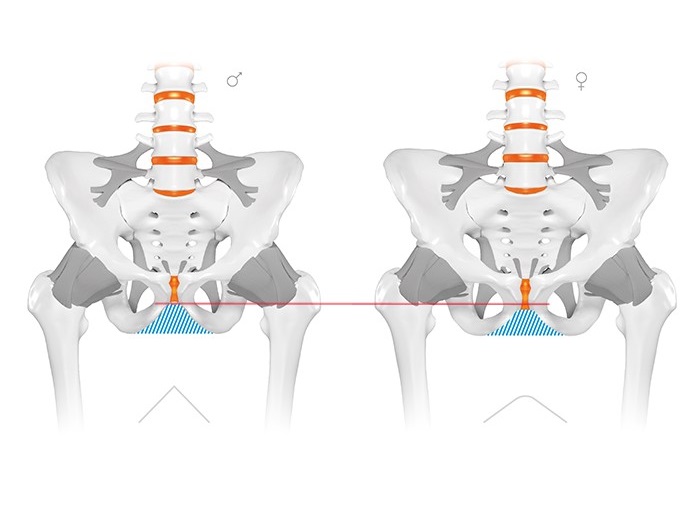
But women also benefit from a lowered saddle nose. Women’s inverted V-shape is flatter compared to men’s, mainly because the inside of the female sacrum (Fig 1: C) is lower than that of the male sacrum (Fig 4). Thus, a lowered saddle nose also prevents excessive pressure for women, specifically on the pubic bone.
Both men and women benefit from a saddle with a lowered nose.
Hard versus soft
Most customers in the store inquire about a soft saddle, typically made from a gel-based material. Intuitively, this idea seems plausible. Someone experiencing saddle discomfort often assumes that a softer saddle will provide relief.
During cycling, a rhythmic interplay of relief and load occurs in the pelvis. From a saddle, we expect it to adapt (longitudinally) to the shape of the cyclist’s pelvis.
With (too) soft material, the cyclist will eventually sink deeply into the saddle surface. This has two negative consequences that reinforce each other:
- In the case of an upright riding position, the sit bones cannot sufficiently fulfill their supporting function, resulting in too much pressure on the pubic bones.
- The combination of soft, pliable material and deep sinking causes the saddle surface to remain in contact with the body throughout the entire pedaling motion, creating continuous counterpressure that burdens the blood vessels, lymphatic channels, and nerves without interruption. The saddle essentially sticks to the pelvis during the entire pedaling motion.
The result is poor blood circulation in the pubic area (Fig 5 & 6).
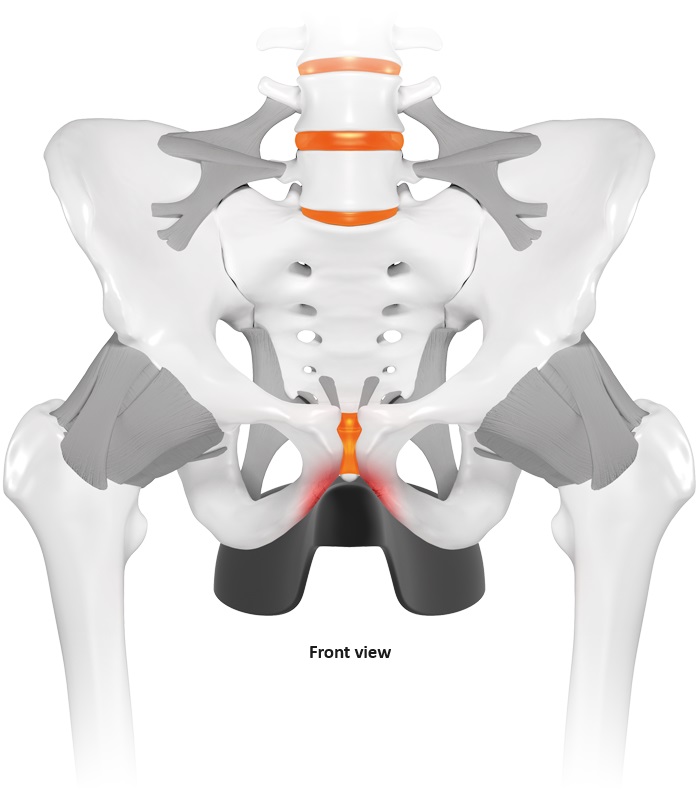
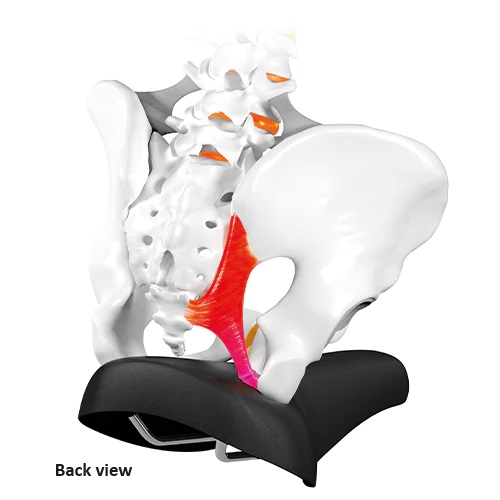
With harder material, however, the sit bones will receive sufficient support, and the alternating relief/load will effectively lead to intermittent detachment from/contact with the saddle surface.
For cyclists who take longer rides (1 hour or more), we therefore recommend saddles that do not sink deeply.
Saddle Pain Due to Friction
Friction can also lead to saddle pain, especially when less experienced cyclists embark on long rides. This discomfort often involves irritated skin at the contact points.
The cause is not necessarily excessive pressure, but rather the continuous rubbing of the saddle cover, the fabric of your pants, and your skin during pedaling.
The solution lies not in a different saddle, but in using cycling shorts (with chamois padding) or cycling underwear (with chamois padding). These garments are designed to minimize friction as much as possible.